


Seminar by Dr. Felice-Alessio Bava "From fundamental questions to technology development, and back: a focus on in situ transcriptomics and cancer".
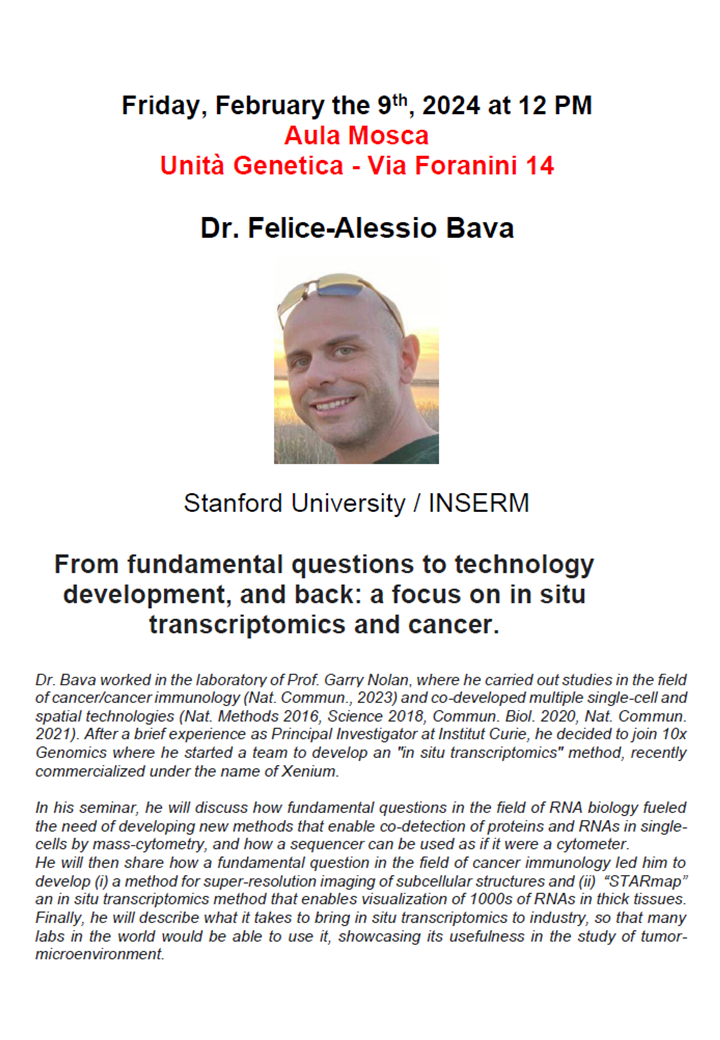
The Department of Molecular Medicine is pleased to invite you to participate to the seminar of Dr. Felice-Alessio Bava (Stanford University / INSERM), entitled:
"From fundamental questions to technology development, and back: a focus on in situ transcriptomics and cancer".
The seminar will take place in the Aula Mosca, via Forlanini 14/16, starting from 12pm on Friday 9 February 2024.
Biosketch:
Dr. Bava worked in the laboratory of Prof. Garry Nolan, where he carried out studies in the field of cancer/cancer immunology (Nat. Commun., 2023) and co-developed multiple single-cell and spatial technologies (Nat. Methods 2016, Science 2018, Commun. Biol. 2020, Nat. Commun. 2021). After a brief experience as Principal Investigator at Institut Curie, he decided to join 10x Genomics where he started a team to develop an "in situ transcriptomics" method, recently commercialized under the name of Xenium.
In his seminar, he will discuss how fundamental questions in the field of RNA biology fueled the need of developing new methods that enable co-detection of proteins and RNAs in single-cells by mass-cytometry, and how a sequencer can be used as if it were a cytometer. He will then share how a fundamental question in the field of cancer immunology led him to develop (i) a method for super-resolution imaging of subcellular structures and (ii) “STARmap” an in situ transcriptomics method that enables visualization of 1000s of RNAs in thick tissues. Finally, he will describe what it takes to bring in situ transcriptomics to industry, so that many labs in the world would be able to use it, showcasing its usefulness in the study of tumor-microenvironment.